CARD SCAN LAB / Card guides
Which Charizard card do I have? Versions that look alike
A familiar fire-breathing Charizard illustration is a starting point, not a complete identification. Several releases reuse it, and different English Base Set printings share 4/102. Read the whole card before comparing prices: language, number, set marks, edition stamp and copyright line answer different questions.
By Card Scan Lab · Editorial check:
1. Build an identification record
Photograph the complete front, then the number, the area below the illustration and the copyright line. Record what is actually printed, including ex, EX, GX, V or other name additions. These designations are part of the identity; “Charizard” alone covers many different cards.
Start with the card’s language. The English comparisons below do not create a universal edition checklist for Italian or Japanese copies. Do not translate a Japanese card into an English catalog entry merely because its artwork matches.
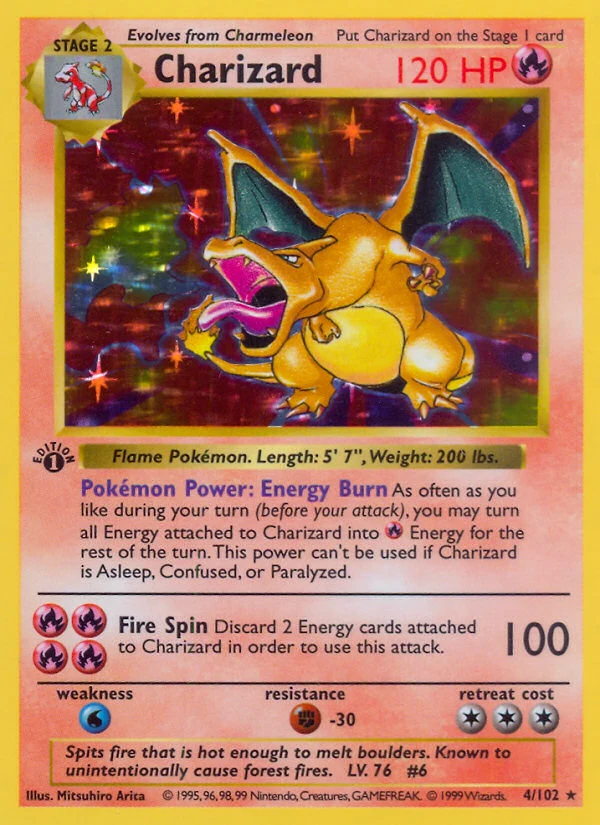
Reference card: English first-edition Base Set Charizard 4/102. Annotations: 1 edition stamp, 2 artwork frame and shadow area, 3 collector number. The diagrams below are schematic comparisons, not photos of other printings or proof of authenticity.
- Language and name
- Number and release
- Edition stamp
- Artwork frame shadow
- Anniversary logo
Continue with: How to identify a Pokémon card by set and number.
2. Separate the main English Base Set printings
For the English Base Set Charizard 4/102, a 1st Edition stamp below the illustration at the left and an artwork frame without a drop shadow identify the expected visual combination for that printing. A missing stamp does not immediately mean Unlimited: the separately cataloged Shadowless printing also lacks that drop shadow.
The familiar English Unlimited version has no 1st Edition stamp and has a drop shadow along the artwork frame. Compare the printed border, not a shadow cast by the sleeve or lighting. Read the copyright line too and keep any differing date in the record; broad “Unlimited” listings may not settle every printing detail.
These are identification clues, not an authenticity test. A stamp can be imitated. If the stamp, frame, text and reference disagree, leave the printing unresolved and seek a specialist assessment before treating it as a rare edition.
Continue with: Holo or reverse holo? Check where the light moves.
3. Check two later lookalikes
XY—Evolutions Charizard is number 11/108 in the official checklist. That changed identifier is a useful way to avoid labeling it Base Set from the illustration. Match the release and check the physical finish before using a price for it.
Celebrations puts Charizard in its Classic Collection. Its 4/102 deliberately resembles the old card’s number, so inspect the 25th-anniversary Pikachu logo and the rest of the printing. “It says 4/102” does not resolve this comparison. The official Celebrations checklist lists the card separately from the main set.
This is a comparison of common confusions, not a complete Charizard catalog. If neither example matches, do not force a choice. Other releases and commemorative versions require their own entry, including a check of the card’s material when relevant.
Continue with: Pokémon card condition: Near Mint, Excellent and Played.
4. Confirm what a scan selected
In Card Scan Lab, compare the first candidate with the physical card and inspect the other candidates when needed. Confirm the set and number, then the supported language and available printing. A correct Pokémon name with the wrong release remains a wrong identification.
A front photo may leave the foil or small print unclear. Take a close-up for your records and use a light-angle check for the surface. The scanner does not authenticate, assign a grade or evaluate the condition of your copy.
Continue with: How to read a Pokémon card reference price in EUR.
5. Compare only equivalent prices
Use an EUR reference for the matched release, language and printing. Read its source, date and reference condition. A graded 1st Edition sale is not a useful direct value for a worn ungraded Unlimited copy; neither is a modern remake’s listing.
If the exact variant has no price, keep that uncertainty visible. There is no responsible single “Charizard price” or fixed multiplier between versions. Establishing which card you own comes before deciding how to sell, keep or evaluate it further.
What to remember
- 4/102 can describe different releases and printings.
- English Shadowless and 1st Edition are separate catalog categories.
- Match language, printing and condition before comparing values.
Frequently asked questions
Does no 1st Edition stamp always mean Unlimited?
No. For English Base Set Charizard, an unstamped Shadowless printing exists. Inspect the artwork frame and compare a matching reference.
Is every Charizard with the classic illustration from 1999?
No. Later releases reuse the illustration. Evolutions 11/108 and Celebrations Classic Collection are two examples to check.
Can these English shadow rules identify an Italian or Japanese copy?
Do not transfer them automatically. Identify the language and release first, then use a reference for that market’s printing.